The La Pampa case
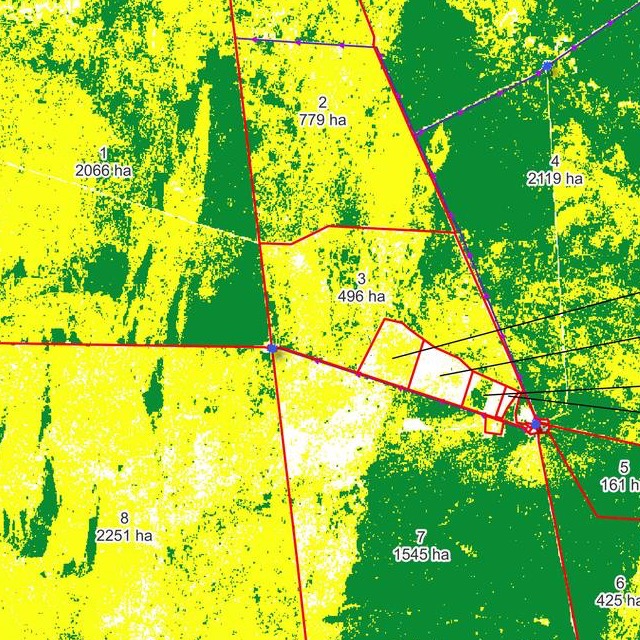
A grassland steppe estancia in the caldenal of La Pampa, Argentina, diagnosed on the ground in April 2026. Undergrazed and over-rested. In this climate the land cannot restore itself. Only management can bring it back to a productive, restored landscape.
Three environments, one property
Fire, grazing and roller-chopping made these differences, and management can unmake them. The open steppe carries a cow on 2.4 hectares. The closed shrub steppe needs ten. The whole thesis is moving hectares from the first row to the last.
| Environment | Hectares | Cow-equivalents today | Hectares per cow |
|---|---|---|---|
| Closed shrub steppe | 3,894 | 403 | 10.0 |
| Shrub-grass steppe | 5,347 | 880 | 6.0 |
| Grass-shrub steppe | 749 | 311 | 2.4 |
| Total | 9,990 | about 1,600 | 6.3 |
Vegetation classified from satellite imagery and ground-truthed in April 2026 by the region's holistic-management network. Cow-equivalent: a cow weaning a 160 kg calf.
The plan
Own cattle to today's capacity. The most urgent water points and subdivisions. Staff hired and trained. Grazing planned holistically, twice a year. Monitoring begins.
1,600 cow-equivalents · investment about USD 1.6M
Estimated livestock revenue about USD 0.9M a year
New water and pipelines across the whole property, roads for fire and stock, yards and housing, subdivisions that lift density and lengthen rest. No intervention in the closed shrub steppe yet.
2,250 cow-equivalents · investment about USD 0.3M
Estimated livestock revenue about USD 1.55M a year
3,500 hectares of the densest shrub steppe opened into diverse grassland under a provincially approved plan, then grazed and rested by design.
3,500 cow-equivalents · investment about USD 2.2M
Estimated livestock revenue about USD 2.4M a year
Water and wire are the cheapest interventions in ranching. That is the value.
Capital and livestock revenue by phase as modelled by the consultants who wrote the diagnosis; phases two and three can be funded from the ranch's own cash flow. The target return is our base case and will be confirmed in the business plan, which is shared under confidentiality.
Why here
Semi-arid caldenal trades at a fraction of comparable grazing land elsewhere. Bought unploughed, in one title, an easy day from the capital.
Argentina is where holistic planned grazing has its longest record on large properties, and the team that wrote the diagnosis is the team available to run the plan.
Cattle are priced at export parity. Land is priced in dollars. We model the currency conservatively, and carbon at zero.
Figures are from an independent diagnosis commissioned in April 2026 and are illustrations of potential, not forecasts. This page is not an offer. Participation is offered privately to qualified investors on the basis of final documentation.